
A year ago, we told you Net-Inspect® was investing in AI and machine learning to reduce the manual work behind quality and supply chain management. That was a forward-looking statement. It is not anymore.
Several of those investments are live today, running inside the same secure environment our customers across regulated, high-consequence manufacturing industries, from aerospace and defense to medical device production, already trust with their most sensitive quality data. Others are close behind. This post is an update on how Net-Inspect quality management software is progressing with AI: what is already helping our 9,500+ customer companies across 59 countries move faster, what is coming next, and, just as important, how we govern AI so it earns a place in a regulated quality system instead of creating new risk inside one.
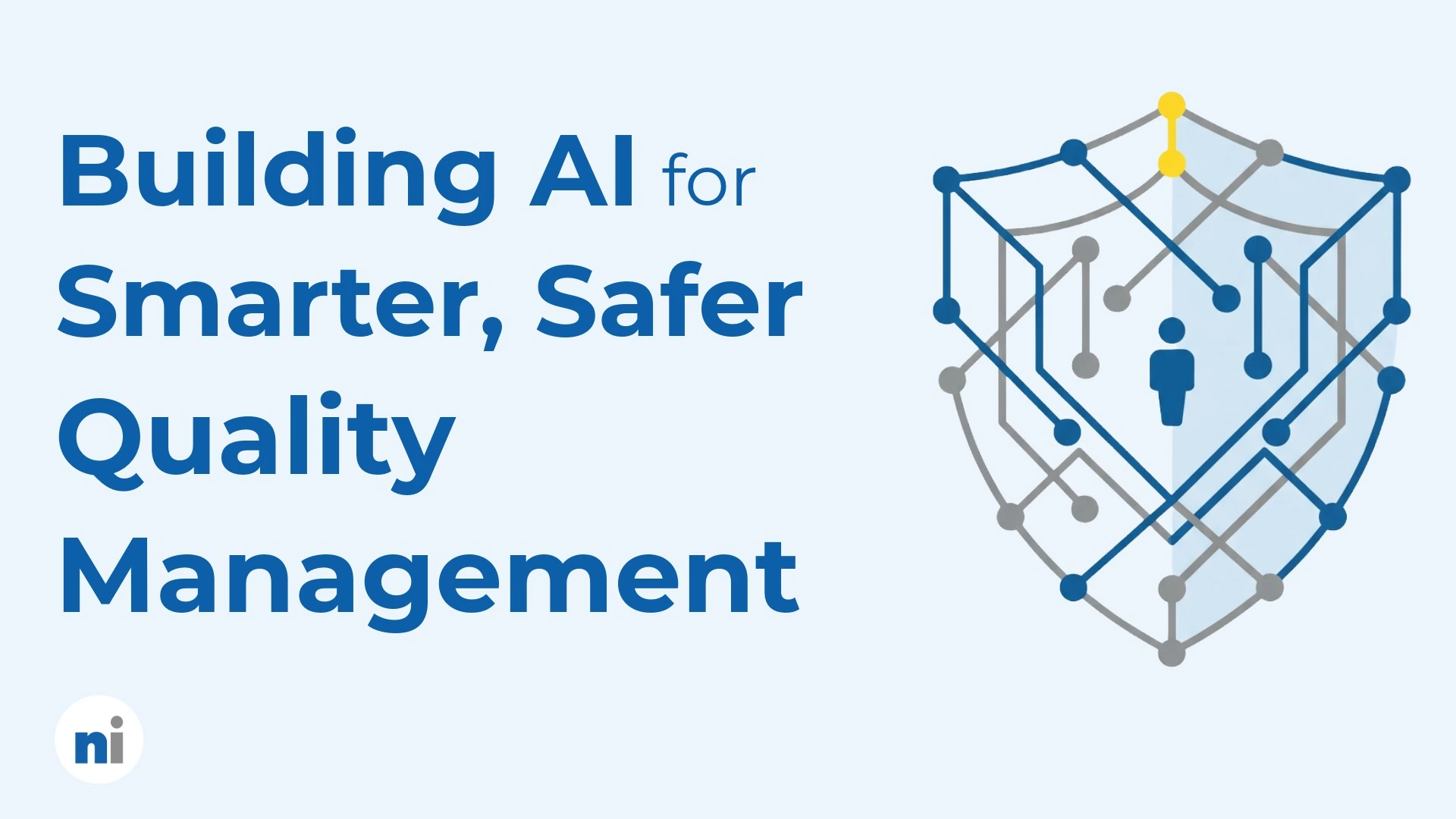
That last part matters as much as the features themselves. In an industry where an inaccurate First Article Inspection Report or an unauthorized technical data disclosure has real consequences, "we added AI" is not good news on its own. That's the real story: how the AI is built, where it runs, and who stays in control of it. We will walk through both.
What's In Active Deployment
 AI-Powered Ballooning. Ballooning a 2D engineering drawing by hand typically takes two to eight hours, and that time comes directly out of a quality team's capacity for actual inspection work. The Balloon Tool's Auto-Balloon feature uses AI-driven OCR to read the drawing, extract dimensions, accurately interpret GD&T callouts, notes, and tolerances, and auto-populate AS9102 Forms 1, 2, and 3, all inside Net-Inspect, with no export to a separate ballooning tool and no break in the digital thread from drawing to approved FAIR. This is one of the clearest examples of AI doing something that used to take hours in minutes, and it is available now.
 AI Search. This feature empowers users to ask a plain-English, natural-language question, such as which suppliers are qualified to perform penetrant testing to ASTM E1417/E1417M-21e1, and get an instant answer pulled directly from their own FAI data. No report to build, no screen to hunt for. AI Search is in production readiness now, with the same security model as everything else in this post: it will run entirely inside your FedRAMP-compliant environment and query only the FAI and supplier data already stored in your Net-Inspect account. We will share more as launch details firm up.
 Supplier Directory. Finding the right supplier for a special process or a hard-to-source material means knowing your own supply base as well as you know your own shop. The AI-powered Supplier Directory searches across your supplier network to surface the right match faster than digging through spreadsheets or asking around.
 PDF-to-FAIR Conversion. Many FAIRs still start life as a PDF, whether from a legacy system, a supplier who is new to Net-Inspect, or a customer requirement. PDF-to-FAIR Conversion automates turning that document into a structured FAIR record, so the data becomes usable inside the platform instead of sitting locked in a file.
 Agentic FAI Review. The heaviest part of First Article Inspection has always been the paperwork surrounding the part, not the part itself. Net-Inspect's Agentic FAI Review reads and validates the purchase order, drawing, material certifications, and special process certs automatically, checking them against each other instead of leaving that cross-referencing to a quality engineer with four documents open at once. The engineer still makes the call. The AI just gets the supporting documents in front of them already checked.
What We're Building Next
Two capabilities are earlier in development. AI-assessed Corrective Action effectiveness will help quality teams see whether a CAPA actually resolved the underlying issue, rather than relying on a manual review weeks or months later. And we are working on AI that can process large volumes of quality data, across FAIRs, NCRs, and supplier performance history, to surface patterns a person would otherwise have to go looking for. Neither has a committed release date yet. We will follow the same rule for both that we followed for everything above: we will tell you what they do and how they are governed before we tell you they are ready.
How We Govern AI
Security built in, not bolted on. This is the part we think matters most, and it is also the direct answer if you landed here from a "how we use AI responsibly" link inside the product.
Every AI capability in Net-Inspect runs exclusively inside Microsoft Azure Government. AI model services are delivered through Azure OpenAI Service on Azure Government, which is contractually separate from commercial OpenAI: Microsoft commits that your prompts, completions, and data are not used to train any model and are never shared with OpenAI or any other third party. Azure Government itself is a FedRAMP High certified environment, built for U.S. government and defense work. That is a statement about the infrastructure Microsoft operates, and it is worth being precise about it: Net-Inspect's own platform maintains FedRAMP Moderate Equivalency (Class C), independently assessed every year by Coalfire Systems, a certified third-party assessment organization, against the full NIST 800-53 Moderate control baseline.
Underneath that infrastructure, five principles govern every AI feature we build, today and in the future:
Security First. AI processing is confined to U.S. Azure Government regions, and no customer data leaves that environment. That is enforced at the infrastructure level, not left to a policy document.
Data Privacy and Ownership. Your organization owns its data. By default, it is never used to train any AI model, shared or Net-Inspect-specific. If an organization ever wants to opt in to a program that improves our AI using its own data, that participation is explicit, disclosed in advance, and reversible.
Human Oversight and Auditability. AI in Net-Inspect assists people. It does not replace their judgment. No AI output automatically triggers a workflow step, an approval, or a record change without a person taking that action. Every AI-assisted output is logged and treated as a quality record, subject to the same review and retention controls as the rest of your quality system documentation.
Organization-Level Control. Some AI features are core to the platform and available by default. Others are extended features that your administrator chooses to enable, limit, or restrict to specific users and roles. We will always tell you which category a new capability falls into before it reaches your account.
Compliance and Ethical Use. Before any AI tool surfaces controlled technical data, Net-Inspect checks that the requesting user is authorized to see it under applicable export control rules. We do not deploy AI in ways that put people at risk, falsify a quality record, or work around a regulatory control, and every new AI capability goes through internal compliance review before release.
If you want the full detail behind any of these five principles, including how they map to DFARS 252.204-7012, ITAR/EAR, CMMC Level 2/3, and AS9100/Nadcap quality record requirements, that is documented in full on our AI Principles for Quality Management.
Where This Is Headed
AI-powered quality control does not replace the people running quality and supply chain programs across regulated manufacturing. It is built to give them back the hours currently lost to manual ballooning, document chasing, and cross-referencing paperwork by hand, so that time goes toward the judgment calls that actually need a person. That is the same problem Net-Inspect has worked on since 2001, and AI is the next tool in that work, not a departure from it.
If your team is evaluating how AI fits into a regulated quality environment, or you want to see any of what is described above in your own data, we are happy to compare notes.
*The AI investments and capabilities outlined represent strategic intentions and are subject to change based on market conditions or customer feedback. Actual product features, timelines, and availability may differ from those described.
Available on Microsoft AppSource
The global leader in supply chain and quality improvement software.
Net-Inspect Privacy Policy and Terms of Service
© 2026 Net-Inspect - All Rights Reserved
2026.10.26 (build 2)